Virupaksha Temple, Hampi
Faith
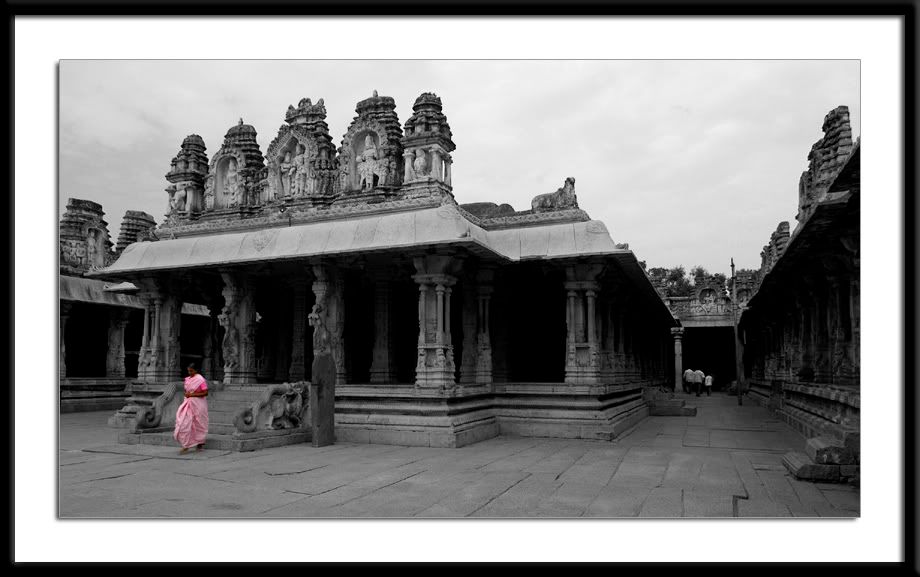
From our visit a few years ago, to the Virupaksha Temple in Hampi, Karnataka.
click image for larger version
Faith
From our visit a few years ago, to the Virupaksha Temple in Hampi, Karnataka.
click image for larger version
Kamakshi Canteen, Ponda, Goa
After performing the puja at the Ramnathi Devasthan, I sneak away to the canteen beside the front entrance. They make the best missal and ussal paav. As I gorge myself, I notice these two guys taking a Chai break. Both were caught up in their own thoughts and did not utter a single word to each other. Prolly none were needed. By their mere presence they seemed to support each other.
click image for larger version
Closeup of the wall calendars
From left:
Vishnu and Lakshmi;
Krishna demonstrating his all pervading form and as Arjuna's charioteer;
Saraswati, Lakshmi and Ganapati;
Lakshmi (in a form represeting the divine mother incorporating all the other devis in her! yes, deep)
Venugopal (Krishna playing the flute)
It was a dream of mine to walk up the mountains to the Tirupati Temple. When I shared this with M, the 14 km hike up more than 4000 steps did not dissuade her. My dream became her's too!
Last summer, after a week-long tour of Aihole, Badami, Pattadakal and Hampi, we took an overnight train to Tirupati. My cousin dropped us off at the base of the hill, and drove on ahead. We started walking up the hills just after 11 on a scorching hot day, with temperatures reaching 41 deg C (105 deg F).
As we started, we realized that it was a tradition here to smear the riser of each step with ochre turmeric paste and the bright vermilion sindhur. Mainly women performed this service - an act of self-sacrifice in thanks for, or in anticipation of, wishes fulfilled. Witnessing scores of women, young and old, so devoted, is what ultimately got us to the top of the mountains. What a beautiful and enlightening experience!
At the start of the walk, this life-sized figure demonstrated the correct manner of prostrating before the temple. It too was not spared the colorful demonstration of devotion.
Along the way I witnessed nearly 50 women smearing turmeric and sindhur. I gazed in wonder at their back-breaking act of devotion. Here, two women pay homage to a step. One smears the turmeric paste, while the second overlays the red naam or tikka. Then she places a small leaf on each step.
Unusually in this case, a young man followed and atop each leaf he placed a tiny piece of camphor and lit it with a matchstick. And on they went, on and on, seemingly for ever, one step at a time.
Within an hour of walking in the stifling heat, my enthusiasm waned. The camera had started to weigh a ton. Miscellaneous things in my back-pack felt like boulders. We rested often and drank copiously of the Limca or nimbu soda from wayside vendors. M's energy never ebbed! She smiled, even as she labored up the stairs, convincing me to hide my own fatigue. Thus we deluded each other, smiled and walked on. We rested often, observed others and spoke only briefly - it took so much more energy to mouth words.
Making nimbu soda: You can almost hear the distinctive TcHuckk! as he releases the marble in the top of the goli-soda bottle ...
... and pours the gurgling soda in the cup with a lime already squeezed in it, along with a spoon of sugar and a pinch of salt. A completely exhausted walker awaits the potion expectedly.
Girls selling mangoes along the way.
Interlude:
The day had not started well. The train was scheduled to reach Tirupati around 7:30 am and we had hoped to start walking in the cooler air. The train was very late and the day was hot! Further, at the temple center near the station, we are told the earliest we could get entry wrist bands was for two days later! Since our plans to head back to bangalore the next day and mumbai thereafter were already fixed, we opted to forgo the temple entry.
As tired feet carried us up, this thought kept gnawing at me. "Despite this long and tiring walk, we may not be able to enter the temple and get darshan, afterall." If I gave up, so would M. I quickly needed a save, particularly as M repeatedly asked, "If we don't have tickets, how are we getting into the temple?" I was at a loss. In desperation I tried to convince her that the divine is everywhere. What's so special about a temple anyway?
"See around you M," I tried, "isn't the sight of all these women performing this service, by itself not worth the walk? Perhaps our destiny was to see this! This devotion by the faithful. To experience it and to learn from them. See! See how despite their poverty and pain, their faith has not wavered. Comparatively, what have we suffered? What right do we have to say that life is unfair? Have we even earned the right to enter the temple?"
Initially, my words were hollow, means to keep M motivated, but the more I mouthed them, I too started believing. I too felt the energy from the devoted women smearing turmeric.
Hear ye! Hear ye all! The divine is not in the womb of the temple on the hill, decorated with diamonds and rubies with prostrating celebrities and rich potbellied merchants. She is here on the steps! In the murmur of the women who faithfully adore each step to her abode. Their breathing is labored and sweat dribbles unnoticed. The divine is here in each step of the aged mother, as she guides her daughter to leave her mark. Her hand steadying her throbbing knees, ignoring the pain. On her lips the name of Venkateshwara! The divine resides in that little girl selling mangoes. Though only a four hour bus ride from Bangalore, - she might as well be a million miles away. Uneducated, she doesn't whine on blogs of how unfair life is. You want to make her day? Buy a mango for a little over 10 rupees (20 cents).
Yes! if you want to experience the divine, skip the air-conditioned drive to the top of the mountain and walk. Walk among the devotees. As they smear turmeric and sindhur, they chant their prayers and wishes. As our own feet fall on each step, I realize, these are not mere blocks of concrete, but lodged inside are the prayers of millions of true devotees who have walked before us. Millions of women who painstakingly smeared each step. Women, tired of body but alive with spirit, who simply said "I leave my prayers on your door step, Srinivasa!" Those are the stairs we walked on. As I raised and lowered each foot, I thought of the prayers bound to each step. What a privilege it was to walk here; on the offerings of so many. The vigor in our strides renewed and we floated on this cloud of prayers.
We walked and we smiled! We had seen the divine here! And experienced her grace. Visiting the temple would be a formality!
End of Interlude
Carving on a doorway. Above the damsel in the intertwined vines, Vishnu's varaha avataar is carved. A common observance at all Vaishnava temples.
Ananjaya (or Hanuman) towers over the devotees near the top of the mountain.
Epilogue: Once we reached the top, my cousin had arranged for me to meet with the head priest of the Tirupati temple. He was interested with the book I'm writing on Hindu prayers and agreed to help with discussions of the Venkateshwara stotra. He shared details of various services and traditions at the temple. He showed me an ancient copy of the Venkatachala Mahatmyam which his father (himself a one time head priest at the temple) had given him.
And as we chatted, ... he offered passes for us to visit the temple, early the next morning! :-O After the long and exhausting day, I was simply overcome by relief.
That night we went for a walk to the temple complex and I did not even feel like taking a picture. I had already taken the important pics. What else was there to capture? And yes, the abode of Srinivasa and Padmavati appears a bit hazy here! But I'll come visiting again!
A satellite view of Baanganga. Its the dark green quadrangle on the left.
If you have Google Earth: enter the co-ordinates as above, or in fractional degrees as:
18.945454N 72.793612E
But first, in PREFERENCES and the default VIEW tab, select "Degrees."
After a refreshing early morning run in Mumbai I recounted the route to my parents. I had run from Electric House, via Mantralaya, along the Chowpatty sea face, past Wilson College to the top of the hill.
"That's Walkeshwar hill!" my father informed, "and if you had gone a little further you would have reached Baanganga and the Walkeshwar devasthan (temple or mandir)." My father explained how the Baanganga - the fresh water spring only a few yards from the ocean - came to be by the grace of Shri Rama. Being a Bombayite, I prided myself on knowing every significant site here. How had I missed this important landmark while growing up only a few miles away? Perhaps I was not ready to walk here; here where Rama walked?
On my next day's run, I continued to the top of Walkeshwar hill and over to Baanganga. Here enroute to Lanka, Rama and Laxmana are believed to have rested. And here, I too removed my shoes and stretched my feet.
According to legend, Shri Rama and Laxmana did not find drinking water on this spit of land surrounded by salty ocean. Laxmana then shot an arrow into the ground, springing forth a stream of fresh water. The water pooled forming the Baanganga, (see pic above) refering to the purifying waters of river Ganga brought here by an arrow Baan.
For his prayers, Rama fashioned a linga from the sand, giving the area its name Walkeshwar (Wallu - sand + Ishwar - God). The crudely fashioned linga, with petrified finger marks is now enshrined in a tiny temple right across from the Baanganga.
It was Indu's recent post on Baanganga that inspired me to share these pics with you. The Walkeshwar mandir is to the left on this schematic. For bearings, the above pic was taken from the steps by the Ganapati mandir.
The Walkeshwar devasthan is a tiny shrine and I shot this pic from the doorway. You can see the Nandi (seated bull) in the small antaralaya - foreroom. Past the collection box on the left, the linga is slightly below ground level, under the watchful eyes of the Snake God. Early in the morning, all visitors can pour water on the linga (performing abhishek) and pray.
My fingers traced the ridges on this linga, where fingers had crudely moulded and the whole turned to stone. How many had touched this before me? The blessed Shri Rama! And Lakshmana too! And the millions and millions of devotees before me, thanking the divine for her munificence. And then I realized, how insignificant my life is. A tiny being, a tiny droplet from the ocean of Brahman - the Paramatman. I let the water flow over my fingers over the linga, and watched it swirl away into the unknown. Another devotee had offered a few bael leaves on the linga. I picked one up as a blessing from the divine, touched it to my forehead and carefully placed it in my running shorts.
I picked up my running shoes and walked around the numerous shrines, which have sprouted around this hallowed tank.
In front of the Walkeshwar Mandir, these steps lead to the tank itself. There is a tiny shrine to Ganesha in the niche in the wall, behind where the lady in the red saree is praying to Nandi. The rest of the family appeared to be enjoying their outing here.
The little girl and the younger brother she held, were both mesmerized by the glinting waters of the Baanganga.
Yes! Its the shoes! It is my running shoes which bring me to fascinating places, where I meet fabulous people and take away great memories. And yes, everyday I run is a day to remember! If you see me smiling, its because I am running today!
My nephew Varun, learning to do the Sandhya Vandan, a service in preparation for reciting the Gayatri Mantra. It was about 3 weeks since his Upanayana (thread ceremony) during which he was invested with the sacred thread (see it on his left shoulder) and had his head shaved, marking his "re-birth" as a student of the scriptures, seeking the ultimate truth.
This follows a longer write-up on the Ramnathi Devasthan.
The Mangeshi Devasthan in Goa is a crown jewel of Konkani Temples. The Shiva Linga representing Mangesh, was originally in the ancient temple of Kushastali (Cortalim, Salcete Taluka). When the Portuguese destroyed the original temple in 1561, the linga was relocated across the Zuari River near other konkani temples. The current temple was constructed on land donated by a devotee in the mid- 1800's and has been renovated several times..
Architecturally, the Mangeshi Devasthan is considered highly distinctive of Goan Konkani Style - a mix of several local influences; the Dravidian Vimana, as well as islamic lattices are incorporated. The classically Goan Konkani deep stambha, a seven-storeyed octagonal lamp tower, is very distinctive and observed on many paintings, brochures and travel guides on Goa. Also made famous because this is Lata Mangeshkar's Kula-devasthan.
We visit the Mangeshi temple on every visit to Goa. Its only a few kms from the Ramnathi Devasthan and most of the Konkani temples are clustered together. Just a quick darshan and we will not stay long. But the memories will stay with us for ever.
Note: Pics are either from our visit in September 2002 or September 2004.
The side of the Mangeshi Temple (September 2004). It is difficult to get a good picture of the temple and the complete Deep stambha. I'll have to be more creative during my upcoming visit in May.
Women selling flowers, garlands and streamers along the path leading to the temple. Badly exposed pic, but I like the colour and pattern on the back wall and the lazy atmosphere (Sept 2002)
From Sept 2004; More flower sellers outside the Mangeshi Devasthan. Obviously my photo taking skills have improved here - or maybe just a more expensive camera ;-)
This picture of a lady selling cucumbers was previously posted here; and reposted for completion. Enjoy!
© 2005 Arun Shanbhag
The Ramnathi Devasthan (place of God, or Temple) in Ponda, Goa is our family's ancestral temple. Millenia ago, groups of Konkani families settled in extended family-based communities in Goa. Each community had their own spirits, which protected them from evil and satisfied their spiritual curiosity. The spirits and associated deities also received gratitude for agricultural and female fertility. With time, these spirits evolved into a full-blown God. Ramnath was the benevolent God of our community. His two spouses (Shanteri & Kamakshi) probably represented the heightened fertility required for survival in those days. And we have our own ferocious spirit – Betal, who is responsible for ‘taking care’ of evil.
When members of the extended family leave the community in search of opportunities, they maintain connections to their family gods, also called the Kuladevata. “Kula” refers to the home-base of the extended family community, where the lineage of the family can be traced back to. Thus the Ramnath deity is our family’s Kuladevata. All members of the original community and their descendants are called Kulavis (core family members). All Konkanis will have a Kuladevata Devasthan and are in turn kulavis of that temple..
When Madhvacharya’s fervor spread through Karnataka in the 12th and 13th century, the Ramnathi Devasthan became incorporated into the Vaishanava tradition and became part of the larger Hindu Dharma. Thus Ramnath Dev became a local incarnate of Vishnu, and his spouses Shanteri & Kamakshi became incarnates of “Lakshmi.”
During the Portugese Inquisition in the 1500’s, all Konkani (and Hindu) temples in Goa were destroyed, and churches built in their place. Many Hindus were forced to convert and many others sacrificed their lives for their faith. Libraries, scriptures and literature were systematically destroyed. Devotees smuggled temple deities to safe haven across the Zuari River in what was then part of Goa ruled by a Muslim Sultan from Bijapur. Many Konkanis escaped with few belongings to start new lives elsewhere. Some migrated north to Maharashtra, and most migrated south and settled along the Karnataka Coast. Konkani communities also settled in Cochin and other parts of Kerala.
Devout Konkanis built small temples in each town they settled and kept their faith alive. With the literature destroyed, a dispersed and migrant community maintained the konkani language as an oral tradition. In the 1700s, the Portuguese ended the Inquisition under threat of the British taking over the colony. A status quo was maintained till 1961 when the Portuguese finally left Goa and it became an Indian state. Konkani is now a recognized distinct language in India.
Konkanis dispersed all over the world, thronged to the remote corners of Goa to pay their respects at their Kuladevata temples. Many maintained in wooden shacks were refurbished. Konkani temples are now thriving complexes, representing a symbol of a resilient people; hard working and god fearing.
Considering the circumstances, Konkani temples rebuilt over the decades are not architectural masterpieces. Further, all modern Konkani temples are not where their original communities grew, but clustered across the Zuari River, within 10 miles of each other.
Under the Portugese rule, devotees visited clandestinely from the surrounding states, often involving day-long walks through forests. Appropriately, Konkani temples provide basic accommodations to their devotees. Today, accommodations have been upgraded, but are still spartan. Devotees can get a very basic room at the temple for between $1-$2 per night. One of Goa’s best kept secrets, I’d say. The temples in Ponda are about an hour from Panji the capital, or from the airport near Madgao.
Every time I visit India, I make a beeline to our kuladevata Ramnathi Devasthan in Goa. It is the tradition at Ramnathi and other Konkani temples, for kulavis to visit the deity as soon as you arrive - even before you wash your feet. We leave our sandals/chappals at the door and with dusty feet rush inside to pay our homage to our father protector, guardian and closest confidante. It is akin to the return of a prodigal son (or daughter) and our father wants to see us ASAP, even before we wash our dusty feet. This first visit is thus called “dhool bhaet” (dusty meeting). Only after we pay our respect to the deity, do we then visit the office, rent a room, freshen up and come back into the temple for a proper service.
Due to the remoteness of the area, there are no restaurants around, but for a small shack serving bananas and cold drinks (see pic of shack in this post). We usually ask and are invited to the priest’s house for a delicious konkani vegetarian meal - served on a banana leaf. Per tradition, we leave a small donation for the priest’s family. Many a times, the temple has open lunches sponsored by devotees.
After spending a few days in the serenity of the temple grounds, I will proceed south to visit our relatives and friends.
After learning the history of the Konkani temples, my visits to our kuladevata have more fervor and passion. A recognition of the sacrifices made by our ancestors, so that we may live with their chosen faith. A re-affirmation of my faith, and importantly ... courage. Never again will our homes and places of worship be ransacked; and we be forced to choose between the sword or the cross.
Never Again!
Side Entrance of the Maha Mandal (Front Hall). The high ceilings keep this area very cool even in the middle of a blistering summer. Meant for sermons, but perfect for naps in the afternoon.
Monday evenings in the front hall, a procession prepares to take the deity Ramnath Dev, for a tour around the temple.
Ramnath Dev sitting in a palki (palanquin) and paraded around the temple complex.
As Ramnath Dev proceeds around the temple, a crowd of devotees follow. The Deep Sthamba is lit at night and it's a beautiful sight. At the conclusion of the procession, an elaborate service is held inside the temple and followed by a sumptuous dinner. Hee Hee! Now you know why I really like to hang out at the temple :-)
The early morning mist crawls away as a buffalo grazes in the fields across from the Ramnathi Devasthan. Nicely highlights the remote location of the temple.
© 2005 Arun Shanbhag
click image for larger version
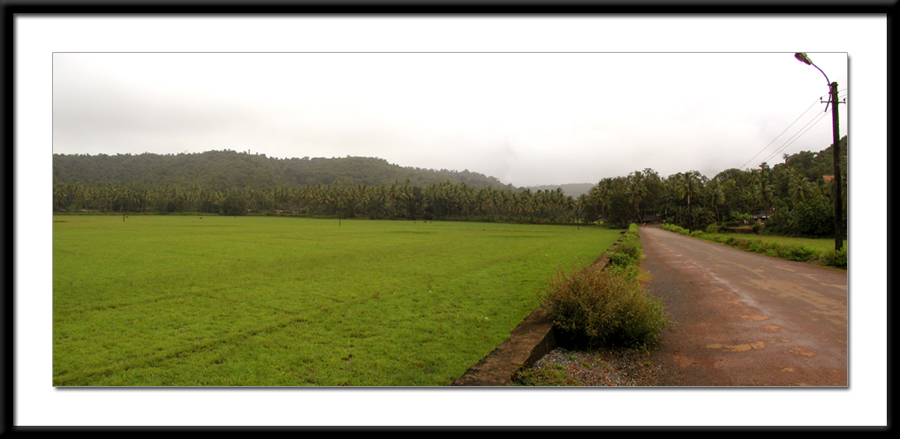
When in India last September I made a short trip to visit our ancestral temple near Ponda, Goa. The early morning flight reached Goa before 8:00. Enroute to the temple I saw this quintessential Goan field, and had the driver stop. It was a partly cloudy day and the overnight rains had soaked through.
And to the right, this!
And turning back on the road, this!
This tiny store is across from the Ramnathi Temple. Even as a kid, I remember this "Maama" (uncle in konkani) tending this store. Years ago, it was a tiny metal box about 4 feet across, now he has a much larger, sturdy laterite construction. I make a beeline for those bananas, still hanging on the ghadaay. You pluck which ever you want. Reminded me of my abbu's home in Bhatkal. Such ghadaay were always hanging in the veranda, and as we kids ran by, we'd pluck one and feed the skin to the cows :-) Such fun!
Here's a close crop. Pick one.
© 2005 Arun Shanbhag