Showing posts with label Kumta. Show all posts

Wednesday, February 15, 2006

Cashew Nuts: To your Health

Factories play an important role in India's rural economy. They provide jobs for local men and women, which translates into money to buy food, send kids to school, buy medicines if needed, repair and maintain a house and save some money. Villages and towns in India (as elsewhere in the world) don't need an handout, they need a hand-up! People are willing to work hard, but they need jobs with good working conditions and a decent pay. And customers who are willing to pay a fair price for their products. On every visit to rural india my ears are alert for news of well run companies creating jobs for locals.

In the Konkan town of Kumta, I visited the Sahyadri Cashew Processing factory run by Mr Murlidhar Prabhu. He is a cousin of a cousin.


I was particularly impressed that he hired a lot of women in his factory. Of the more than 250 people he employs, only 8 were men and more than 240 were women. WoW!

"But do they like working here," I asked. "Most of our new workers are younger daughters, sisters, and relatives of those already working here," he explained, implying that if the pay was not good, or work conditions onerous, workers would not be bringing other family members in to work. Within a few years of working the women are able to save a decent amount of money. They generally leave when they get married and move out of town. Their ability to earn a living also makes them more marriageable, to a better person and gives them the confidence to seek other jobs wherever they move.

We need more such social entrepreneurs in the villages and towns of India. No! We do not need more television sets, or dainty models selling shampoo, or fancy soaps. Certainly not coffee shops or liquor bars or 'menthol' cigarettes or posh grocery stores. So the next time you munch on the nuts, remember all the folks working in the factories in rural india and elsewhere whose job depends on your choices. Did I mention nuts are actually very good for you?

How are Cashew Nuts Processed

cashew fruit pic from an Indian Cashew Trade Association website.

The hard, gray, raw cashew seeds, perched below the fruit are collected and dried. Seeds are first steamed and allowed to cool in large heaps on the factory floor. The quick heating and cooling causes the kernel to separate from the shell. Operating steam boilers and loading /unloading large bags of cashew seeds was the only tasks in this factory performed by men. Women handled all other jobs here.

After cooling, women on tables with rudimentary cutters expertly position each seed in a v-grip using the hand lever. Then a foot operated lever snips the outer shell longitudinally in half. Cut seeds tumble through a hopper to a basket on the floor.


... where another woman separates the whole nut kernel from the shell. The gray shell has corrosive agents and women rub oil on their hands to protect from the corrosive effects. The shells are sold off to companies which extract oils, which are apparently an important ingredient in marine paint used on ships and docks. May explain why most ships are painted gray?


Collected nuts are dried in an oven, making the skin brittle and easy to remove. While I suffer at this chore, the women fly through at a dizzying speed. They use a tiny knife to scrape and release the skin on the inner surface of the nut. Then the rest of the skin just falls off. Preliminary sorting of the nuts is also performed at this stage.


On these tables the cashew nuts are sorted depending on their size, colour and if they are chipped. Halfs and pieces of nuts are also sorted by size. This grading determines the ultimate price of the cashew nuts.


The sorting tables were in a large well-lit area.


The cashew nuts undergo extensive quality control before packaging. Nuts are placed on a conveyor belt and inspected. Over a sieve, dust and other contaminants are sucked. Over a magnetic table, metallic contaminants are removed. Cashew nuts are then packaged in vacuum in large packs (greater than 10kg). Most of the cashew nuts from this factory are exported through bulk dealers. They do have their own private label that you saw above. Depending upon the needs of the customer, the factory also does some post processing such as roasting cashew nuts with spices.


Note: All factory pics were shot in Sept 2004 at the Sahyadri Cashew Factory, using my Olympus C4040, 4MP point and shoot digital camera. The opening cashew fruit pic was from an indian cashew trade association website.

Wednesday, February 8, 2006

Kumta: School Kids


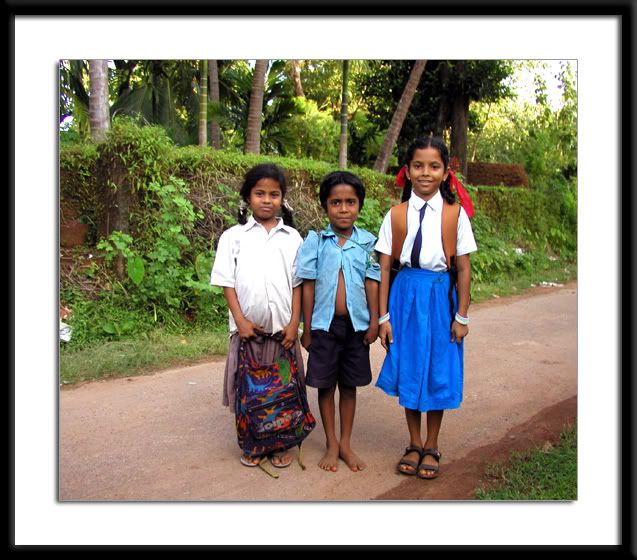
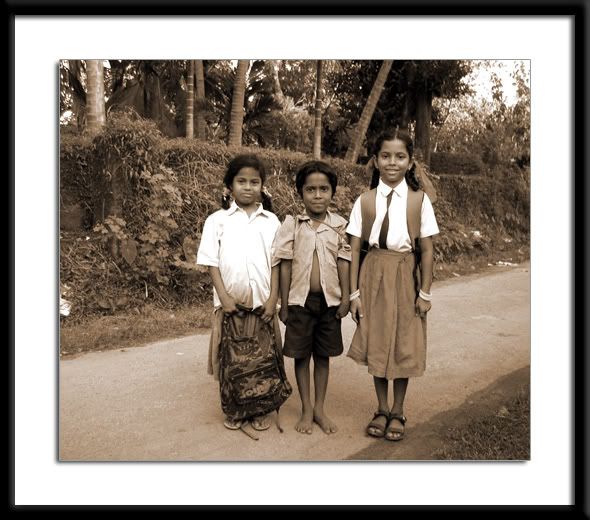
Outside my cousin-brother's house in Kumta, these kids were walking back from school. They seemed eager to pose. After shooting this pic, I offered them one of the Britannia cream biscuit packs I always carry in my bag. They grabbed and ran - jumping in joy!

Do you like this Sepia toned pic better?

Wednesday, January 25, 2006

Kumta 3: Field of Dreams


(click pic for a larger version)

Road leading from my cousin's house to the Kumta market. It's a 10 minute walk. Bicycles are family vehicles here. Mom and infant are calmly enjoying the ride on the rack.

Note: open drains to carry heavy rain water run-off; cows resting ahead on road side.

And across is this spectacular rice field. Despite having seen this field hazaar times, I am ever in awe. Depending on the time of day, or year, its a different scene. These pics are from an evening in September 2004; the light has a golden tinge and shadows are getting long. Monsoon rains have just ended, and the crop is starting to mature.

In this God-fearing country, the parting greeting is: Dev Bare Karo! literally, May God do you good!

(click pic for a larger version)

Tuesday, January 24, 2006

Kumta 2: Main Street


The Vegetable market sits on one end of Main Street Kumta. Always a treat to walk the remaining few blocks and watch people. The stores are tiny and carry whatever you would need. Nothing fancy here, just life's essentials. Several temples are on this street, and thus flower sellers everywhere.

Notice the reddish tinged road. That comes from the red Laterite rock this entire Konkan region sits atop. In the konkan, everything is made from laterite: buildings, fence walls, bus-stop shelters, stores and even gutters draining road sides. Crushed laterite gravel is used on the shoulders of all roads. Even the dust has a reddish tinge, and so does the normally black asphalt road. After a few days in the konkan, my sense of white clothes now account for a trace of red in it :-)

Let's take a stroll down Main Street!
The Venkateshwara Devasthan is in the center of town. I love exploring the inside of this very old, beautiful temple. Piles of sand and gravel outside point to imminent construction - pray nothing gaudy!


Nearby is the Shanteri-Kamakshi Temple. A thread-ceremony was going on inside and these girls, dressed in new clothes, were welcoming guests. Women received flower strands for their hair, men (and women) got sprinkled with perfumed water. Note the girl in red reaching for the small chrome sprinkler.

After walking in the hot sun, my cousin and I decided to gate-crash this ceremony for some cool lemonade and mithai. We smiled at the girls, got doused in perfumed water and smiled our way to the back of the temple where the lemonade was still being mixed. There as we waited, the assistant picked up a block of ice sitting on the bare floor and tossed it in the giant pot (aaarrrghhhh!) !! I had no intention of getting an upset stomach at the start of my holidays. Mithai too was nowhere to be seen :-( We walked out dejected. O yes, I did bow my head at the shrine.


Right outside the temple I tried taking a pic of the squatting flower-seller, and this women walked right into my field. Her expression suggests she was carrying a huge burden on her already drooping shoulders.


Parched throats made us dash to the corner shop with the red and white awning (Nayak's Cold drinks?). Note the women selling an assortment of flowers, vegetables or fruits. Generally whatever grows on their plot.


On the back table as we waited to order Nimbu-soda, a local person still sitting there was sipping, what looked like a glass of cold-coffee. Raagi Neeru (Nanchane water) he noted. I remembered my grandmother making Raagi Neeru for us kids playing in the hot summer sun. Then we find, the owner's wife makes it at home. So it was a no-brainer - Delicious too! They also served Teela Udak (white sesame water). Had to try that as well. After a few glasses of each, we were well prepared to brave the midday sun. Note empty glasses on table! :-)

Apparently a very simple recipe for these cool-drinks. Roasted Nanchane (aka Raagi) are ground with some coconut gratings, gur and water. Thats it! Ayurveda experts would swear at how it would 'cool' the body from the inside! Amen!

Sunday, January 15, 2006

Kumta: Jewel of the Konkan


On every visit to India, I follow a similar schedule. We head to Goa to pay our respects at the Ramnathi Devasthan in Ponda. From there we head south along the coast to Kumta in Karnataka.

Kumta is a sleepy town. The busiest part is Main Street, called paent, which is only a few blocks long. The place for any and all your shopping. Its where all the locals 'hang-out' too. There is not much else to do in Kumta. Rest and relax.

And best of all - I get to speak konkani all over town! My konkani is good enough, I easily pass off as "from Mumbai" (which is not incorrect)! Yes, every shop-owner, rickshaw driver, stall-wallah, lady selling vegetables, and their brother speaks Konkani. :-) So even among strangers, I feel at home.

In the mornings, the local market is buzzing. It's only a few rows of vegetables and fruits. And not surprisingly, friendly folks and juicy vegetable and fruits everywhere.

Join me for a short tour of the Kumta Vegetable Market!
This pair of smiley guys seemed to have the biggest stall there.


These brinjals were mouth watering. Appears to be a hybrid between a "Gullaen" and the brinjal. Can someone shed more light on this?


Yes! MANGOES! BTW, this was from our May-June trip. Those little green ones are deceptively sweet. Called manik-bhat, a local variety and very popular all over the konkan coast.


Who said, sucking up cannot be sweet!
Thats the way to eat the manik-bhat mangoes. Wash (optional), pinch the stem and make a small hole. Gently roll and squeeze the mango, so the pulp is ejected into your mouth. Suck, fast. Discard the leftover at a nearby cow who will glady finish it off :-)


As I negotiated my way around the market shooting pics and striking conversation with the shop-keepers, this girl selling a grab-bag of spices and colors was giggling. Not sure what she found humorous. When I turned my camera on her, ... she was full of modesty.


A tighter crop of the 'spice girl', highlighting her endearingly beautiful features.


For every guy who ever wondered: What women really want?
The largest crowd was in front of this stall which sold bangles, earrings, nose-rings, bracelets, anklets and other trinkets. Note the women who have orange flowers in their hair (3rd from left; 2nd and 4th from right). Those are the traditional aboli flower strands, very common in the konkan. (see next pic).


On the market, a woman was selling these (l to r) drumsticks topped with woven aboli flower strands; dainty lady-fingers (a longer and delicate version of the Okra available in the US); a ripe pineapple; more drumsticks (these appear less fleshy) and a bowl with more flower stringers.


My question is this: Even if the women selling flowers, spices, and the small guys selling mangoes, were to sell all their produce by the end of the day (highly unlikely), how much money would they earn? Would it be enough to buy other food for their familiy, clothes, school tuition? savings perhaps? Something to think about!

My visits to Kumta are times for introspection. While M stays at home and rests and lazes around, I walk the markets, the alleys, the temples, and talk, talk and talk. With the guy selling mangoes, the vegetable seller, the woman here, the flower seller there, the shopkeeper elsewhere. I want to know them, see the world from their eyes. With all my education and training, what can I do for them? What can you do for them?

Wednesday, November 9, 2005

Konkani Delicacy: Kadgi Chakko

As in previous years, M got to make the delicious Kadgi Chakko, for Boston's Konkani Diwali gathering last weekend. M excels at it, and is one of my favorites.


Kadgi (a variant of the jackfruit), is a small round-ish fruit with a bumpy thick skin. Much like the jackfruit, but not spiky. The meat inside is white, the large seeds and rest are all edible. Chakko, is a typical coconut-based 'sukka' (dry) masala. The spices are delicate and don't cover-up the kadgi taste. Its gritty and fibery texture goes well with the basic rice and dhal. I like it with chapattis. Important to get the deep red color of the chakko. Keeping Kadgi Chakko in mind, during our recent visit to Kumta, we picked up a bag of baedgi mirsaang red peppers - known for their bright color and delicate spice.

Making Kadgi Chakko: A quick recipe
Ingredients & Procedure:
1. 3 cans of kadgi (will feed an average family of four; or 1 hungry guy and his wife!)
2. Freshly roast 15 red chillies (M uses 10 baedgi mirsang for their color and 5 of the garden variety spicy red peppers from here)
3. Separately, roast 1 tsp coriander seeds + ¼ tsp methi seeds
4. Blend: ½ cup grated coconut, roasted chillies, coriander and methi seeds. Add ½ tsp tamarind (not pulp) and ½ tsp jaggery/gur
5. Boil kadgi pieces separately and drain. Cut wedges in smaller pieces, if you prefer
6. Blend other ingredients finely.
7. (For PhaNNa/Tadka) Heat 1 tsp oil, throw in 1 tsp mustard seed. As it starts to sputter, add about 10 kari pattar (curry leaves). Take off the heat and mix with the blended masala.
8. Heat the blended masala on a low flame till it starts to simmer. Add salt to taste and kadgi pieces.
9. Mix well, taking care not to damage the kadgi pieces.
10. Heat till the water has evaporated, leaving a ‘sukka’ (dry) masala.
11. Leave aside for about 15 minutes for the spices to “soak in.” In the meantime, help clean the dishes!
12. It is considered polite to serve your guests first, and then serve yourself, one serving at a time!

Baedgi mirsang for sale at a market store in Kumta