Virupaksha Temple, Hampi
Faith
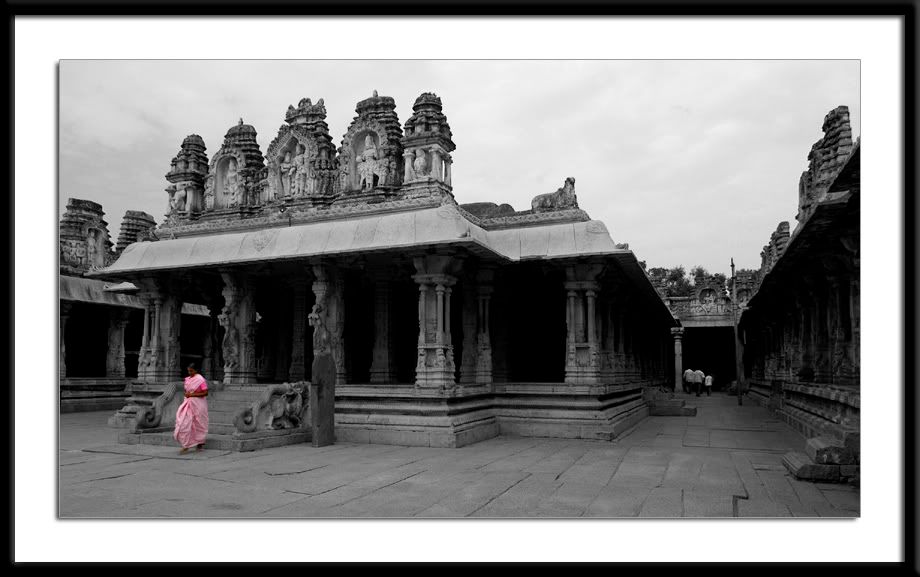
From our visit a few years ago, to the Virupaksha Temple in Hampi, Karnataka.
click image for larger version
Faith
From our visit a few years ago, to the Virupaksha Temple in Hampi, Karnataka.
click image for larger version
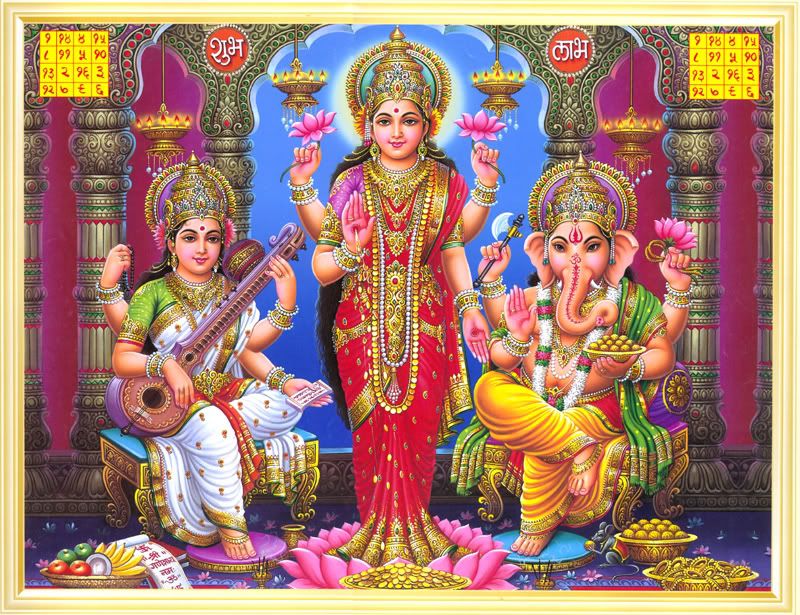
Growing up, I remember seeing this in every home, either as a calendar or a picture frame. I bought this poster in Mumbai on my last trip. Love the bright colors!
Beautiful, no?
click pic for a larger version
My cousin brother is a bhat-maam (priest) in the small konkan town of Honavar, 15 miles south of Kumta. His parents had insisted he get a college degree - so after his BA in Economics he still decided to follow their priestly traditions. They live in spartan accommodations beside the temple. I have fond memories of visiting them during my school summer vacations. Every morning we herded cows to a distant pasture. There we would bathe in a local stream! :-) O, what joys for a city brat. Now I only visit during my India trips and don't herd cows. Can't forget my roots, which need constant nourishing!
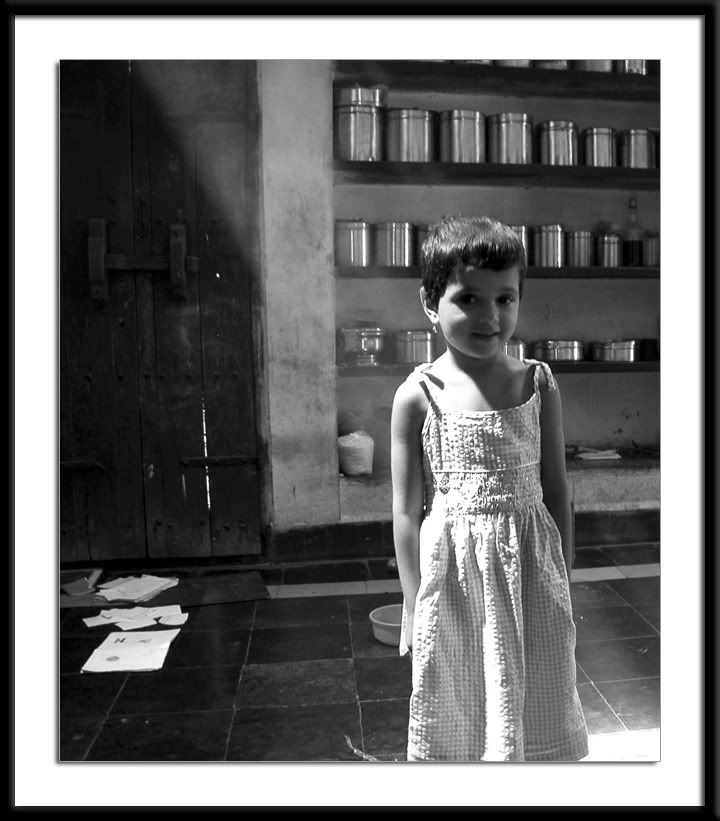
His daughter, Dhanya is the cutest girl I have seen. Here I had to interrupt her doodling on the kitchen floor. The beam of light is from a makeshift skylight. A couple of terracotta tiles in the roof are replaced with a sheet of glass. Wisps of smoke are from the burning wood embers used for cooking. They have a gas cooking range, but my aunt grew up using a wood fire and rarely uses the range. The old-style door has a sliding latch and the open pantry is lined with steel dabbas.
What do you need to be happy? You'd be right if you guessed - a divine daughter and a row of mithai-filled dabbas! :-) I am currently batting zero for a million!
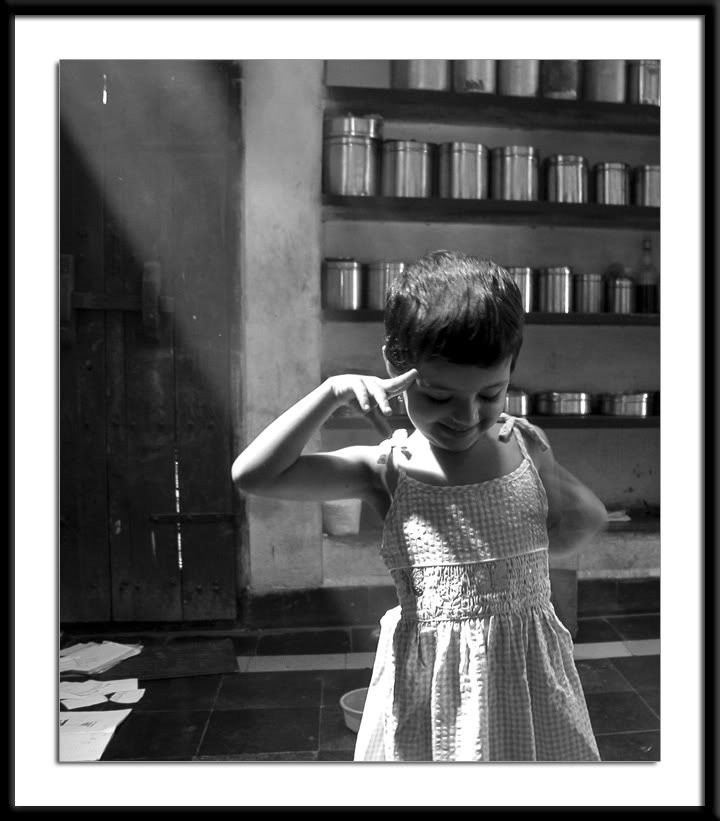
One more of Dhanya
Due to my interest in Konkani Temples in Goa, I have been researching books on the Portuguese occupation in Goa. During the Portuguese Inquisition lasting more than 150 years (1560 - 1812), the Jesuits made a systematic attempt at wiping out the Konkani heritage in Goa. Konkanis were either tortured and killed, forced to convert, or give up their lands and migrate. And all our temples in the older Goa were destroyed. It was many other men-of-the-cloth, particularly Anglicans who spread the horrors of the Inquisition, and put political pressure on the Portuguese forcing it to end the Inquisition.
I have tracked scores of such books from the 18th and 19th century which shed a grim light on the atrocities of the Portuguese. In the midst of an enormous amount of historical literature, there are always the revisionists, trying to cast a softer glow on the Portuguese Inquisition. This one by an ordained priest takes the cake.
A few lines from his work and my related comments.
An Historical Sketch of Goa, Rev. Denis L. Cottineau de Kloguen (DK)
Gazette Press, Madras (1831), Reprinted pp 44-45
Also available digitized from the Library at Harvard College, Cambridge, MA; Pg 69 – 70.
Original text in italics is contiguous in one paragraph; my comments are in regular text.
Background: In this particular paragraph, Denis de Kloguen is trying to defend the Archbishop D Alexins de Menezes.
DK - … Some acts of violence by the Portuguese agents may have been committed, both before and after him, but they are not to be imputed to him.
AS - Really! Everyone else is to blame, but not the Archbishop.
DK - It is equally false, that, followed by the officers of the Inquisition, he went armed with fire and sword, to compel the inhabitants of Salsette to embrace the Christian religion. The Jesuits converted a great part of them by the usual and most laudable means;
AS - Reminded me of the recent controversial remarks by Pope Benedict 16th: (from the NY Times) "... in Brazil, ... native populations had been “silently longing” for the Christian faith brought to South America by colonizers." The Rev is probably alluding to such an "innate longing" for torture and death.
DK - but in order as they thought, the better to detach the remainder of the inhabitants from worship of idols, they destroyed all the temples and pagodas.
AS - Much to the embarrassment of the Jesuits, many forced converts continued to visit temples and kept to their traditional Hindu ways. The only way to prevent this was to destroy the temples. How many is “all”?
DK - This however, had the contrary effect; and the Pagans, exasperated at this circumstance, rose up in arms, murdered five jesuits, and several Portuguese.
AS - Did the Jesuits really expect anything else? Note the choice of the word “murdered” when associated with the Jesuits and the Portuguese. BTW, when “all temples and pagodas” were destroyed, how many of the locals were killed? Smoothly overlooked.
DK - The Governor then felt himself obliged to use arms likewise to reduce the rebels; and of course did not after wards permit the temples to be rebuilt.
AS - “reduce the rebels” here is an euphemism for “massacring the population”! And since when did the locals become the “rebels” in their own lands?
DK - But in all this, the Archbishop had nothing to do, and what is certainly better proved, are the good works and the pious establishments of Goa, of which he is the founder.
AS - Surprised he has not been nominated to be made a Saint!
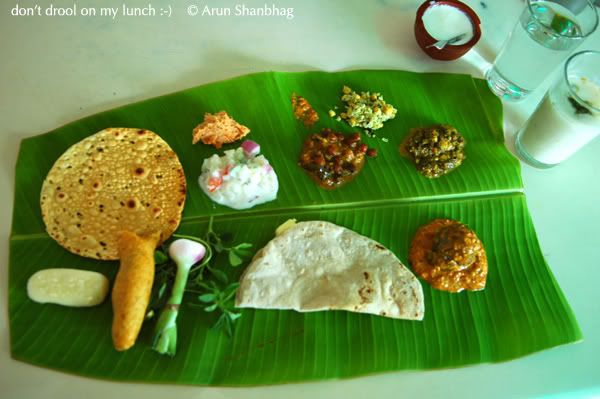
Our recent visit to Bangalore was M's first, and she wanted to tour the city. My cousin was kind enough to let his driver take us around for the entire day. After a busy morning, we visited Kamat's Yatri Nivas in Gandhinagar to explore the Northern Karnataka cuisine. The northern part of Karnataka is home to hard working farmers and their hardier cuisine. The staple diet includes Jolada Roti (leavened bread made from jowar flour), served with butter, spicy curries and chutneys.
In the fourth floor restaurant, lunch is served on a clean banana leaf, and waiters in the traditional garb of a dhoti, kurta and topi, decorate the leaf with a dazzling array of multicoloured vegeterian dishes. The scallion, a few sprigs of methi (fenugreek), roasted papad, orange coloured spicy garlic and onion chutney, a tomato cucumber raita; lentil cucumber pachhadi, spicy brinjal (eggplant) curry, a greens dish and another lentil curry. Phew! Home made yogurt (or curd) is set and served in an earthern cup (see top right of pic). Fluffy rotis come straight from the outdoor cooking area (see next pic). I cautiously apply the butter, tear off a piece of the roti and use it to scoop each dish in turn. Finger licking yummy! As we finished each roti or curry, servers magically appeared with more of what we just finished. There was also a glass of buttermilk spiced with crushed ginger, chopped peppers, curry leaves and hing. After a few rounds I can barely chew a morsel, and as waiters lined up to serve more, I had to cover my leaf with my hands and insist on not being served any more. Of course, they also had rice and Kolambo, which I just could not partake of. Then they bring out the best ... fruit salad with mango ice-cream! However full I am, I can always eat dessert!
All this for Rs 100. Yes, its about 2 US dollars!!! (That is how much a cup of coffee alone will cost you at one of those Western-styled Coffee shops in Bangalore or Mumbai).
We were so full, we could barely walk down the stairs and ... *don't roll your eyes* we actually took a room at the hotel for a two hour nap. ;-) After freshening up and a nice cup of 'Kapi' we continued on our bangalore city tour (pics in next post)
Making of Jolada Roti:
At three such stations, workers continually kneaded, rolled and roasted the bread on the pan over a charcoal hearth. The roti stays soft when roasted on the pan alone; if it is flipped over the open hearth, it roasts to a nice crisp. They serve both varieties.
Full Disclosure: Our relative owns the restaurant and I did not have to pay for lunch! :-)
On our visit to India in June, we paid a short visit to Goa. Starting on the early morning flight from Mumbai and after visiting the Ramnathi Devasthan, we arrived at the beach-front resort in Colva, early in the afternoon. We were so fatigued, both of us promptly fell asleep. The drumming of the heavy rains outside pushed us deeper in sleep. On waking up around 5 pm, and a leisurely coffee, we ambled onto the beach. The rains had stopped, but the skies were still overcast.
As the sun set, the clouds broke up and we were treated to this beautiful medley. My camera was busy, but I also remembered to just sit in one place and let it all soak in. It so relaxed the spirit to see kids frolicking in the water, adults acting like kids, and many other aimlessly strolling through the surf. The simple joys! We walked back and forth on the beach reminding ourselves over and over again - This could be the life. No deadlines, no projects, no students, fellows, or bosses. No stress! No paychecks! :-(
We walked till the sun dipped below the horizon and then found our way back to the room. See one more previously posted here.
Once the clouds broke, it was easy - just point to the horizon and click! Everywhere you turned, a light show was in progress.
Before the clouds parted, I had to think of composition, coconut trees, the beach and the confluence of sky and sea.
Prolly should be titled, How not to shoot a Panorama!
With the range of lights and colors, the automatic setting adjusted for each frame separately. It was a disaster trying to put it all together. But it seems to convey what i saw and felt at Colva Beach!
Serene beauty and Peace!
click image for larger version
Kamakshi Canteen, Ponda, Goa
After performing the puja at the Ramnathi Devasthan, I sneak away to the canteen beside the front entrance. They make the best missal and ussal paav. As I gorge myself, I notice these two guys taking a Chai break. Both were caught up in their own thoughts and did not utter a single word to each other. Prolly none were needed. By their mere presence they seemed to support each other.
click image for larger version
Closeup of the wall calendars
From left:
Vishnu and Lakshmi;
Krishna demonstrating his all pervading form and as Arjuna's charioteer;
Saraswati, Lakshmi and Ganapati;
Lakshmi (in a form represeting the divine mother incorporating all the other devis in her! yes, deep)
Venugopal (Krishna playing the flute)
I thank all delegates who attended the recent Konkani Sammelan in Toronto, Canada, and made it a phenomenal success. On a personal note, your enthusiastic response to my talk Konkani Temples in Goa was heartening.
In responding to the innumerable requests for the bibliography, I have listed them below. Over the next week, I will also upload all photographs as well. So please check back. The talk itself followed the outline I followed in two articles I had previously written. Please check my posts on the Ramnathi Devasthan, and the Mangeshi Devasthan. You may recognize many of the pictures, and see some new ones too.
On pg 57 of the Sammelan Souvenir is my article "Travels in Kumta." You can read the original article posted on my blog, along with photographs in color. Don't miss the three follow-up articles on Kumta as well. And then, a photo-essay on the processing of Cashew Nuts in Kumta. (Click through for articles).
Last week during Gudi Padva, M indulged me with some freshly made Puran-polis. A konkani delicacy! For those who have not tried one, imagine a paratha stuffed with a blend of chana-dal, jaggery and elaichi. Liberally spread tuup (clarified butter) on warm puran-polis and ... Yumm! M made 10, she ate 2 and I finished 8! What sacrifices the indian woman makes! A true pativrata. Hee Hee! And with a glass of milk, I didn't need dinner!
At home in Mumbai, the boiled chana-dal is well blended. Here, the chana though well cooked, was not all well-blended, resulting in their discernible outline in the puran-polis. For me, that added to the experience. I particularly enjoyed the heterogeneous texture while eating, as opposed to the creamy puran-polis in Mumbai.
My other favorite is a variation of the puran-poli called "Sanzori." Identically made, but the stuffing is a cream of wheat-based shira. This variant is commonly made in North Canara and I suspect has a marathi influence. Sanzoris don't crumble and are perfect while reading, not having to worry about crumbs between the pages.
Below are a few pics of sanzori making at our home in Mumbai, during Ganapati 2004.
Sanzori Making in Mumbai
In preparing most foods, particularly during Ganapati and other festivals, all my kakis (aunts) and other relatives will get together and help out. Here, some of them are in the midst of making sanzori.
First, the 'kanik' (yellow sticky flour) is spread on the palm (see aunt on the right); then, a round ball of stuffing (Shira in this case) is placed in the center (see left); and the kanik is 'pulled' so it covers the entire ball of shira (top). Making puran-polis is identical, except the stuffing is made of chana-dal, jaggery and elaichi.
A couple of cousin-sisters then roll the 'dough ball.' Covering the dough ball first with flour, prevents sticking.
Then, quickly roasted on a pan.
And cooled over old newspapers!
My aunts have this habit of slapping my wrists every time I pull one out! Ouch! Well we first offer this to Ganapati, and then partake of them as his gift to us! Makes us appreciate all the good fortune we are blessed with and thank God for the same. We do the same here in our home in Boston.
Go ahead! Pick one up, they have already been blessed, and I won't slap your wrists. Enjoy!
© 2005 Arun Shanbhag
It was a dream of mine to walk up the mountains to the Tirupati Temple. When I shared this with M, the 14 km hike up more than 4000 steps did not dissuade her. My dream became her's too!
Last summer, after a week-long tour of Aihole, Badami, Pattadakal and Hampi, we took an overnight train to Tirupati. My cousin dropped us off at the base of the hill, and drove on ahead. We started walking up the hills just after 11 on a scorching hot day, with temperatures reaching 41 deg C (105 deg F).
As we started, we realized that it was a tradition here to smear the riser of each step with ochre turmeric paste and the bright vermilion sindhur. Mainly women performed this service - an act of self-sacrifice in thanks for, or in anticipation of, wishes fulfilled. Witnessing scores of women, young and old, so devoted, is what ultimately got us to the top of the mountains. What a beautiful and enlightening experience!
At the start of the walk, this life-sized figure demonstrated the correct manner of prostrating before the temple. It too was not spared the colorful demonstration of devotion.
Along the way I witnessed nearly 50 women smearing turmeric and sindhur. I gazed in wonder at their back-breaking act of devotion. Here, two women pay homage to a step. One smears the turmeric paste, while the second overlays the red naam or tikka. Then she places a small leaf on each step.
Unusually in this case, a young man followed and atop each leaf he placed a tiny piece of camphor and lit it with a matchstick. And on they went, on and on, seemingly for ever, one step at a time.
Within an hour of walking in the stifling heat, my enthusiasm waned. The camera had started to weigh a ton. Miscellaneous things in my back-pack felt like boulders. We rested often and drank copiously of the Limca or nimbu soda from wayside vendors. M's energy never ebbed! She smiled, even as she labored up the stairs, convincing me to hide my own fatigue. Thus we deluded each other, smiled and walked on. We rested often, observed others and spoke only briefly - it took so much more energy to mouth words.
Making nimbu soda: You can almost hear the distinctive TcHuckk! as he releases the marble in the top of the goli-soda bottle ...
... and pours the gurgling soda in the cup with a lime already squeezed in it, along with a spoon of sugar and a pinch of salt. A completely exhausted walker awaits the potion expectedly.
Girls selling mangoes along the way.
Interlude:
The day had not started well. The train was scheduled to reach Tirupati around 7:30 am and we had hoped to start walking in the cooler air. The train was very late and the day was hot! Further, at the temple center near the station, we are told the earliest we could get entry wrist bands was for two days later! Since our plans to head back to bangalore the next day and mumbai thereafter were already fixed, we opted to forgo the temple entry.
As tired feet carried us up, this thought kept gnawing at me. "Despite this long and tiring walk, we may not be able to enter the temple and get darshan, afterall." If I gave up, so would M. I quickly needed a save, particularly as M repeatedly asked, "If we don't have tickets, how are we getting into the temple?" I was at a loss. In desperation I tried to convince her that the divine is everywhere. What's so special about a temple anyway?
"See around you M," I tried, "isn't the sight of all these women performing this service, by itself not worth the walk? Perhaps our destiny was to see this! This devotion by the faithful. To experience it and to learn from them. See! See how despite their poverty and pain, their faith has not wavered. Comparatively, what have we suffered? What right do we have to say that life is unfair? Have we even earned the right to enter the temple?"
Initially, my words were hollow, means to keep M motivated, but the more I mouthed them, I too started believing. I too felt the energy from the devoted women smearing turmeric.
Hear ye! Hear ye all! The divine is not in the womb of the temple on the hill, decorated with diamonds and rubies with prostrating celebrities and rich potbellied merchants. She is here on the steps! In the murmur of the women who faithfully adore each step to her abode. Their breathing is labored and sweat dribbles unnoticed. The divine is here in each step of the aged mother, as she guides her daughter to leave her mark. Her hand steadying her throbbing knees, ignoring the pain. On her lips the name of Venkateshwara! The divine resides in that little girl selling mangoes. Though only a four hour bus ride from Bangalore, - she might as well be a million miles away. Uneducated, she doesn't whine on blogs of how unfair life is. You want to make her day? Buy a mango for a little over 10 rupees (20 cents).
Yes! if you want to experience the divine, skip the air-conditioned drive to the top of the mountain and walk. Walk among the devotees. As they smear turmeric and sindhur, they chant their prayers and wishes. As our own feet fall on each step, I realize, these are not mere blocks of concrete, but lodged inside are the prayers of millions of true devotees who have walked before us. Millions of women who painstakingly smeared each step. Women, tired of body but alive with spirit, who simply said "I leave my prayers on your door step, Srinivasa!" Those are the stairs we walked on. As I raised and lowered each foot, I thought of the prayers bound to each step. What a privilege it was to walk here; on the offerings of so many. The vigor in our strides renewed and we floated on this cloud of prayers.
We walked and we smiled! We had seen the divine here! And experienced her grace. Visiting the temple would be a formality!
End of Interlude
Carving on a doorway. Above the damsel in the intertwined vines, Vishnu's varaha avataar is carved. A common observance at all Vaishnava temples.
Ananjaya (or Hanuman) towers over the devotees near the top of the mountain.
Epilogue: Once we reached the top, my cousin had arranged for me to meet with the head priest of the Tirupati temple. He was interested with the book I'm writing on Hindu prayers and agreed to help with discussions of the Venkateshwara stotra. He shared details of various services and traditions at the temple. He showed me an ancient copy of the Venkatachala Mahatmyam which his father (himself a one time head priest at the temple) had given him.
And as we chatted, ... he offered passes for us to visit the temple, early the next morning! :-O After the long and exhausting day, I was simply overcome by relief.
That night we went for a walk to the temple complex and I did not even feel like taking a picture. I had already taken the important pics. What else was there to capture? And yes, the abode of Srinivasa and Padmavati appears a bit hazy here! But I'll come visiting again!
A satellite view of Baanganga. Its the dark green quadrangle on the left.
If you have Google Earth: enter the co-ordinates as above, or in fractional degrees as:
18.945454N 72.793612E
But first, in PREFERENCES and the default VIEW tab, select "Degrees."
After a refreshing early morning run in Mumbai I recounted the route to my parents. I had run from Electric House, via Mantralaya, along the Chowpatty sea face, past Wilson College to the top of the hill.
"That's Walkeshwar hill!" my father informed, "and if you had gone a little further you would have reached Baanganga and the Walkeshwar devasthan (temple or mandir)." My father explained how the Baanganga - the fresh water spring only a few yards from the ocean - came to be by the grace of Shri Rama. Being a Bombayite, I prided myself on knowing every significant site here. How had I missed this important landmark while growing up only a few miles away? Perhaps I was not ready to walk here; here where Rama walked?
On my next day's run, I continued to the top of Walkeshwar hill and over to Baanganga. Here enroute to Lanka, Rama and Laxmana are believed to have rested. And here, I too removed my shoes and stretched my feet.
According to legend, Shri Rama and Laxmana did not find drinking water on this spit of land surrounded by salty ocean. Laxmana then shot an arrow into the ground, springing forth a stream of fresh water. The water pooled forming the Baanganga, (see pic above) refering to the purifying waters of river Ganga brought here by an arrow Baan.
For his prayers, Rama fashioned a linga from the sand, giving the area its name Walkeshwar (Wallu - sand + Ishwar - God). The crudely fashioned linga, with petrified finger marks is now enshrined in a tiny temple right across from the Baanganga.
It was Indu's recent post on Baanganga that inspired me to share these pics with you. The Walkeshwar mandir is to the left on this schematic. For bearings, the above pic was taken from the steps by the Ganapati mandir.
The Walkeshwar devasthan is a tiny shrine and I shot this pic from the doorway. You can see the Nandi (seated bull) in the small antaralaya - foreroom. Past the collection box on the left, the linga is slightly below ground level, under the watchful eyes of the Snake God. Early in the morning, all visitors can pour water on the linga (performing abhishek) and pray.
My fingers traced the ridges on this linga, where fingers had crudely moulded and the whole turned to stone. How many had touched this before me? The blessed Shri Rama! And Lakshmana too! And the millions and millions of devotees before me, thanking the divine for her munificence. And then I realized, how insignificant my life is. A tiny being, a tiny droplet from the ocean of Brahman - the Paramatman. I let the water flow over my fingers over the linga, and watched it swirl away into the unknown. Another devotee had offered a few bael leaves on the linga. I picked one up as a blessing from the divine, touched it to my forehead and carefully placed it in my running shorts.
I picked up my running shoes and walked around the numerous shrines, which have sprouted around this hallowed tank.
In front of the Walkeshwar Mandir, these steps lead to the tank itself. There is a tiny shrine to Ganesha in the niche in the wall, behind where the lady in the red saree is praying to Nandi. The rest of the family appeared to be enjoying their outing here.
The little girl and the younger brother she held, were both mesmerized by the glinting waters of the Baanganga.
Yes! Its the shoes! It is my running shoes which bring me to fascinating places, where I meet fabulous people and take away great memories. And yes, everyday I run is a day to remember! If you see me smiling, its because I am running today!
Factories play an important role in India's rural economy. They provide jobs for local men and women, which translates into money to buy food, send kids to school, buy medicines if needed, repair and maintain a house and save some money. Villages and towns in India (as elsewhere in the world) don't need an handout, they need a hand-up! People are willing to work hard, but they need jobs with good working conditions and a decent pay. And customers who are willing to pay a fair price for their products. On every visit to rural india my ears are alert for news of well run companies creating jobs for locals.
In the Konkan town of Kumta, I visited the Sahyadri Cashew Processing factory run by Mr Murlidhar Prabhu. He is a cousin of a cousin.
I was particularly impressed that he hired a lot of women in his factory. Of the more than 250 people he employs, only 8 were men and more than 240 were women. WoW!
"But do they like working here," I asked. "Most of our new workers are younger daughters, sisters, and relatives of those already working here," he explained, implying that if the pay was not good, or work conditions onerous, workers would not be bringing other family members in to work. Within a few years of working the women are able to save a decent amount of money. They generally leave when they get married and move out of town. Their ability to earn a living also makes them more marriageable, to a better person and gives them the confidence to seek other jobs wherever they move.
We need more such social entrepreneurs in the villages and towns of India. No! We do not need more television sets, or dainty models selling shampoo, or fancy soaps. Certainly not coffee shops or liquor bars or 'menthol' cigarettes or posh grocery stores. So the next time you munch on the nuts, remember all the folks working in the factories in rural india and elsewhere whose job depends on your choices. Did I mention nuts are actually very good for you?
How are Cashew Nuts Processed
cashew fruit pic from an Indian Cashew Trade Association website.
The hard, gray, raw cashew seeds, perched below the fruit are collected and dried. Seeds are first steamed and allowed to cool in large heaps on the factory floor. The quick heating and cooling causes the kernel to separate from the shell. Operating steam boilers and loading /unloading large bags of cashew seeds was the only tasks in this factory performed by men. Women handled all other jobs here.
After cooling, women on tables with rudimentary cutters expertly position each seed in a v-grip using the hand lever. Then a foot operated lever snips the outer shell longitudinally in half. Cut seeds tumble through a hopper to a basket on the floor.
... where another woman separates the whole nut kernel from the shell. The gray shell has corrosive agents and women rub oil on their hands to protect from the corrosive effects. The shells are sold off to companies which extract oils, which are apparently an important ingredient in marine paint used on ships and docks. May explain why most ships are painted gray?
Collected nuts are dried in an oven, making the skin brittle and easy to remove. While I suffer at this chore, the women fly through at a dizzying speed. They use a tiny knife to scrape and release the skin on the inner surface of the nut. Then the rest of the skin just falls off. Preliminary sorting of the nuts is also performed at this stage.
On these tables the cashew nuts are sorted depending on their size, colour and if they are chipped. Halfs and pieces of nuts are also sorted by size. This grading determines the ultimate price of the cashew nuts.
The sorting tables were in a large well-lit area.
The cashew nuts undergo extensive quality control before packaging. Nuts are placed on a conveyor belt and inspected. Over a sieve, dust and other contaminants are sucked. Over a magnetic table, metallic contaminants are removed. Cashew nuts are then packaged in vacuum in large packs (greater than 10kg). Most of the cashew nuts from this factory are exported through bulk dealers. They do have their own private label that you saw above. Depending upon the needs of the customer, the factory also does some post processing such as roasting cashew nuts with spices.
Note: All factory pics were shot in Sept 2004 at the Sahyadri Cashew Factory, using my Olympus C4040, 4MP point and shoot digital camera. The opening cashew fruit pic was from an indian cashew trade association website.
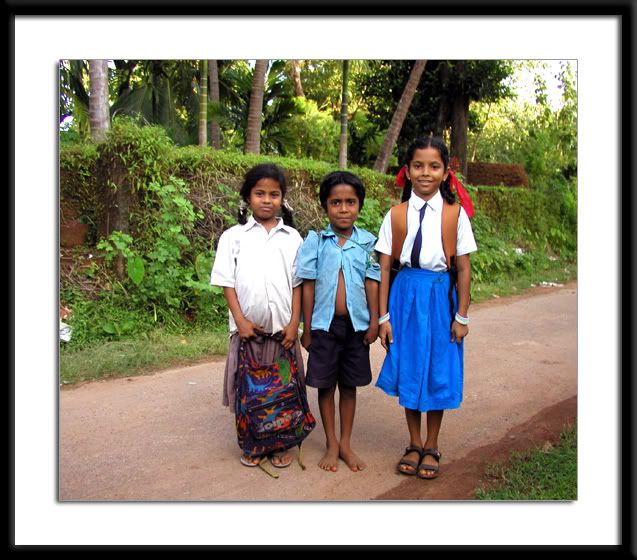
Outside my cousin-brother's house in Kumta, these kids were walking back from school. They seemed eager to pose. After shooting this pic, I offered them one of the Britannia cream biscuit packs I always carry in my bag. They grabbed and ran - jumping in joy!
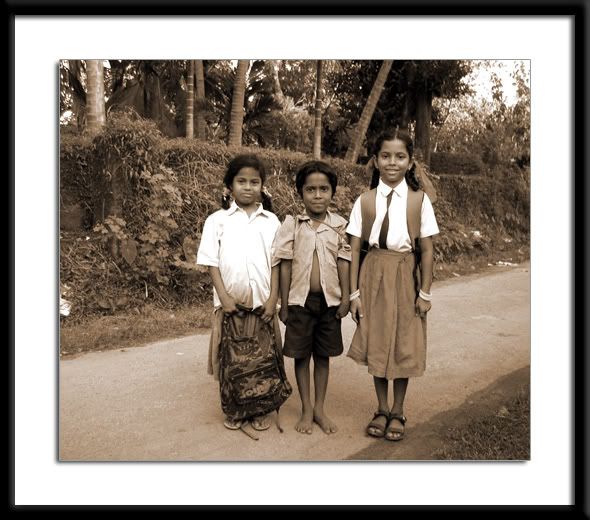
Do you like this Sepia toned pic better?
(click pic for a larger version)
Road leading from my cousin's house to the Kumta market. It's a 10 minute walk. Bicycles are family vehicles here. Mom and infant are calmly enjoying the ride on the rack.
Note: open drains to carry heavy rain water run-off; cows resting ahead on road side.
And across is this spectacular rice field. Despite having seen this field hazaar times, I am ever in awe. Depending on the time of day, or year, its a different scene. These pics are from an evening in September 2004; the light has a golden tinge and shadows are getting long. Monsoon rains have just ended, and the crop is starting to mature.
In this God-fearing country, the parting greeting is: Dev Bare Karo! literally, May God do you good!
(click pic for a larger version)
The Vegetable market sits on one end of Main Street Kumta. Always a treat to walk the remaining few blocks and watch people. The stores are tiny and carry whatever you would need. Nothing fancy here, just life's essentials. Several temples are on this street, and thus flower sellers everywhere.
Notice the reddish tinged road. That comes from the red Laterite rock this entire Konkan region sits atop. In the konkan, everything is made from laterite: buildings, fence walls, bus-stop shelters, stores and even gutters draining road sides. Crushed laterite gravel is used on the shoulders of all roads. Even the dust has a reddish tinge, and so does the normally black asphalt road. After a few days in the konkan, my sense of white clothes now account for a trace of red in it :-)
Let's take a stroll down Main Street!
The Venkateshwara Devasthan is in the center of town. I love exploring the inside of this very old, beautiful temple. Piles of sand and gravel outside point to imminent construction - pray nothing gaudy!
Nearby is the Shanteri-Kamakshi Temple. A thread-ceremony was going on inside and these girls, dressed in new clothes, were welcoming guests. Women received flower strands for their hair, men (and women) got sprinkled with perfumed water. Note the girl in red reaching for the small chrome sprinkler.
After walking in the hot sun, my cousin and I decided to gate-crash this ceremony for some cool lemonade and mithai. We smiled at the girls, got doused in perfumed water and smiled our way to the back of the temple where the lemonade was still being mixed. There as we waited, the assistant picked up a block of ice sitting on the bare floor and tossed it in the giant pot (aaarrrghhhh!) !! I had no intention of getting an upset stomach at the start of my holidays. Mithai too was nowhere to be seen :-( We walked out dejected. O yes, I did bow my head at the shrine.
Right outside the temple I tried taking a pic of the squatting flower-seller, and this women walked right into my field. Her expression suggests she was carrying a huge burden on her already drooping shoulders.
Parched throats made us dash to the corner shop with the red and white awning (Nayak's Cold drinks?). Note the women selling an assortment of flowers, vegetables or fruits. Generally whatever grows on their plot.
On the back table as we waited to order Nimbu-soda, a local person still sitting there was sipping, what looked like a glass of cold-coffee. Raagi Neeru (Nanchane water) he noted. I remembered my grandmother making Raagi Neeru for us kids playing in the hot summer sun. Then we find, the owner's wife makes it at home. So it was a no-brainer - Delicious too! They also served Teela Udak (white sesame water). Had to try that as well. After a few glasses of each, we were well prepared to brave the midday sun. Note empty glasses on table! :-)
Apparently a very simple recipe for these cool-drinks. Roasted Nanchane (aka Raagi) are ground with some coconut gratings, gur and water. Thats it! Ayurveda experts would swear at how it would 'cool' the body from the inside! Amen!